
Please keep a record of what you contribute at work.
I mean more than a list of what your job requires. What did you improve? What became clearer because you were involved? What did you help a team, a client, or a department accomplish? What was happening before, and what happened afterward?
When you have been doing the work for years, it is easy to move on to the next problem without recording what the last one required of you. Then somebody asks for your biggest accomplishment, and you are trying to reconstruct years of contribution from memory.
I see how much harder that makes the work of explaining yourself. You remember being busy. You remember that people depended on you. You know something changed. But now you need the details, and the details are somewhere inside a project you finished a long time ago.
Start the record while the work is still fresh. You will thank yourself later.
A strong accomplishment needs more than a strong adjective
When I work on professional materials, I ask about results. If somebody tells me a department grew, I want to understand what grew. Patient visits? Revenue? Staff? The number of locations? Over what period?
“It doubled” and “it grew every year” are not interchangeable. Neither is useful until we know what the statement refers to.
This is where the back-and-forth happens. I ask for the starting point, the ending point, and the person’s actual contribution. Sometimes that means going back to an authorized source and checking what happened rather than relying on the version that has become familiar through retelling.
The final statement may sound less dramatic than the first description. That does not make it weaker. It may be much more useful because the person can explain it when asked.
You want to be able to sit in an interview and walk somebody through your work without wondering whether a number will hold up.
CareerOneStop’s résumé guidance also recommends describing relevant accomplishments and including numbers that explain results. That is a useful starting point. The numbers still need context, and the language still needs to represent your part accurately. CareerOneStop résumé guidance
Before, after, and me
Here is the question I keep coming back to: what was happening before, what changed afterward, and where were you in that work?
Consider a made-up example. A team’s monthly reporting process took five working days. After a new process was introduced, it took three. That describes a change. It does not yet tell us what you did.
Did you design the process? Identify the bottleneck? Coordinate the people who tested it? Create the instructions? Maintain the system after somebody else built it?
Each contribution can matter. They are different contributions, and your record should make the distinction clear.
In that illustrative example, moving from five days to three is a two-day reduction, or 40% of the original time. Before using that percentage, you would need to know whether the comparison is fair: the same kind of report, a comparable workload, and a defined period of measurement.
A precise percentage attached to a poor comparison still tells a poor story.
The work that does not come with a dashboard
Some of what you contribute will not arrive as a clean number.
You may have helped a new colleague understand a process that nobody had documented. You may have made responsibilities clear enough that work stopped bouncing between teams. You may have helped a client understand an issue and make a decision.
Do not invent a financial return because you think every sentence needs one.
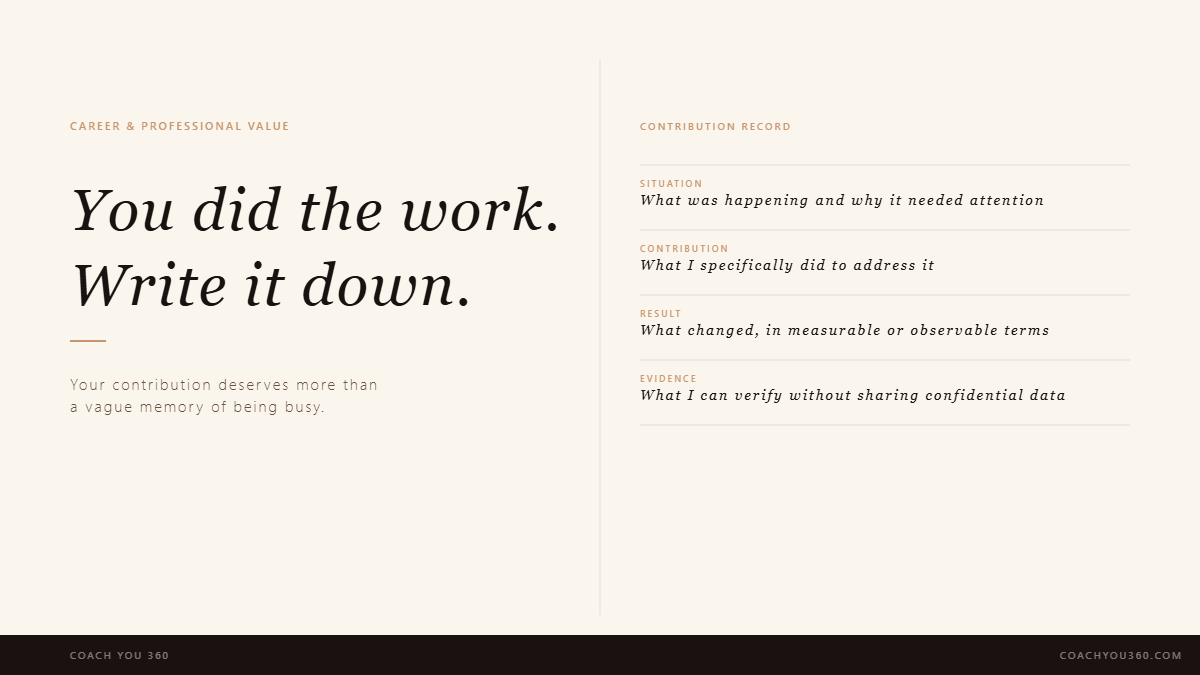
Describe the situation, the action, and the observable result. If feedback is available and appropriate to use, record what it supports. If you do not know the outcome yet, say that in your working record. You can return to it later.
There is a difference between “I led the implementation,” “I supported the implementation,” and “I created the training materials used during the implementation.” Choose the statement you can stand behind.
That clarity respects your work and the work of other people involved.
Keep a contribution record, not a copy of the company’s files
I want you to remember your work. I am not telling you to forward company documents to your personal email or download confidential material before leaving.
A personal contribution record can contain your own permitted, non-confidential description of the work. What you may retain or disclose depends on the information, your obligations, and your employer’s policies. If you are unsure, check before taking or sharing it.
Do not include client or patient identifiers, passwords, internal screenshots, proprietary plans, or sensitive figures just because they would make a résumé sentence more specific.
If a result cannot be shared, look for an approved way to describe the scope and contribution. Do not assume that removing a client’s name makes everything else safe to use.
Keep sensitive employer information out of public AI tools as well. You can ask an AI tool to help structure a generic accomplishment statement without handing it the underlying confidential records.
Make the habit small enough to keep
You do not need a complicated system. A document or spreadsheet can work if you can find it and keep it current.
For each contribution, record:
| Field | What to write |
|---|---|
| Date or period | When the work happened. |
| Situation | The problem, need, or starting point. |
| My contribution | What you personally did and what others did. |
| Result | What changed, with context and a timeframe. |
| Evidence status | Verified, needs checking, or qualitative observation. |
| Sharing limits | What is approved for public use and what must stay confidential. |
Choose a moment you already recognize: the close of a project, the end of the month, or preparation for a review. Take a few minutes to capture the work before the next responsibility replaces it in your memory.
If you are starting late, begin with one project you remember well. Do not try to rebuild your entire career in an evening. Write what you know, mark what you need to check, and keep going.
This record is useful before you need another job
You can use it to prepare for a performance conversation, identify the responsibilities you have taken on, or notice a pattern in the work people trust you to do.
It may also help you recognize something you have been underestimating. Perhaps the common thread is that you explain complicated things clearly. Perhaps you organize work that has been living in everyone’s head. Perhaps you help people stay connected long enough to solve a difficult problem.
Those observations are worth examining. They can inform how you describe your career and what you might want to do next.
A contribution record cannot prevent a layoff or guarantee a promotion. Its purpose is to give you a clearer account of your work so that memory is not doing the whole job when the time comes to explain it.
You did the work. Give yourself a record you can use.
If you want help examining what your experience is worth, explore SEEN — it is free.
Receive The Testing Season
One letter each week. Practical questions, honest stories, and resources you can use. Unsubscribe at any time.